- website cost
- kuwait
- small business
- web design
- budget
What a small business website costs in Kuwait, line by line
The parts of a small business website’s yearly cost in Kuwait: domain, hosting, building, gateway fees and changes after launch, and the questions to ask.
6 min read
Updated
In short
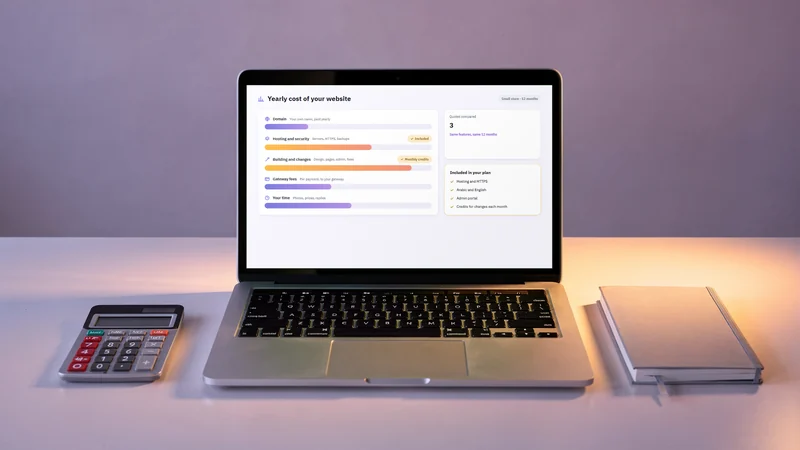
A small business website's yearly cost has five parts: the domain, the hosting, the builder or agency that makes it, the payment gateway's fees, and the changes you need after launch. Ask every provider for the full cost of the first and second year in writing, including who owns the domain and what a change costs, and compare totals rather than monthly headlines.
Ask three providers in Kuwait what a website costs and you may get three answers that look impossible to compare: one monthly fee, one project price, one "free". They differ because each one leaves out different parts. This guide lists the parts so you can compare like with like.
We do not print market prices here, because they change and depend on the provider. Where a provider publishes its prices, we link to the page and say when we checked it. For our own plans, see the pricing section.
The five parts of the yearly cost
1. The domain
Your domain is your address, such as yourbrand.com or yourbrand.com.kw. It is paid every year to a registrar, and the renewal price can be higher than a discounted first year, so ask for both. In Kuwait, .kw names are managed by CITRA, the communications regulator; .com and other endings are sold by registrars accredited by ICANN.
Whatever you choose, register the domain in your own name and keep the login. ICANN publishes the rights and responsibilities of domain holders, including how to move a domain to another registrar.
2. Hosting
Hosting is where the site runs. Website builders usually include it; agencies and freelancers often bill it separately, sometimes through their own account. Ask what it includes: security updates, backups, how much traffic it handles, and what happens if your site is down at night.
3. Building the site
This is where quotes differ most:
- A website builder: a subscription, monthly or yearly, and your own time to set things up.
- An agency: a project fee for the first version, then often a monthly maintenance fee.
- A freelancer: usually cheaper than an agency, but you depend on one person for every change.
Compare what you get at the end: how many pages, in which languages, with which features (bookings, ordering, payments, an admin), and who can change it afterwards.
4. Payment gateway fees
If you take payments online, the gateway charges you, not the site builder. Fees are usually a percentage per payment, sometimes plus a fixed amount, and some gateways add a one-time or plan fee. For example, UPayments publishes its prices on its pricing page. When we checked on 14 October 2026, it listed a one-time fee of 250 KWD for its Single Merchant plan, KNET at "(0.5% + 100 fils) or (250 fils)" per transaction as the page puts it, and credit cards at 2.75% per transaction.
A worked example shows why this matters. If you sell 100 orders a month at 5.000 KWD each and all are paid by credit card at 2.75%, the card fees come to 13.750 KWD that month (500.000 KWD × 2.75%). KNET fees are calculated differently, so ask your gateway to work out your own mix of KNET and cards. Our guide to choosing a payment gateway lists the questions to ask.
5. Changes after launch
A website is never finished: new prices, a new menu, Ramadan hours, a seasonal offer, a new service. Ask how changes are made and what they cost. With an agency, it may be an hourly rate or a monthly allowance; with a builder, it is your own time, or a request in a chat.
Costs people forget
- Photos. Good photos of your products or space sell more than any design. A photographer for half a day can be the best money you spend.
- Writing in two languages. Someone fluent should write or check each language; poor Arabic or English costs trust.
- Your own time. Gathering prices, policies and photos takes longer than most owners expect.
- Printing. QR codes for tables, counters and packaging.
- A review of your policies. Delivery, returns and privacy pages are worth a professional read once.
Some important things cost nothing: a Google Business Profile, for example, is free to create, and it is often the first place customers see your hours and your website link.
Questions to ask before you sign
- What is the total cost for the first year, and for the second year?
- Who registers and owns the domain, and in whose name is the hosting?
- What does the hosting include, and what happens if traffic grows?
- How much does each change cost after launch, and how fast is it done?
- Can I take payments, and does the money go to my own gateway account?
- Can I export my site and my data if I leave?
- What happens if I stop paying: is the site taken down, and is my data kept?
A simple way to compare quotes
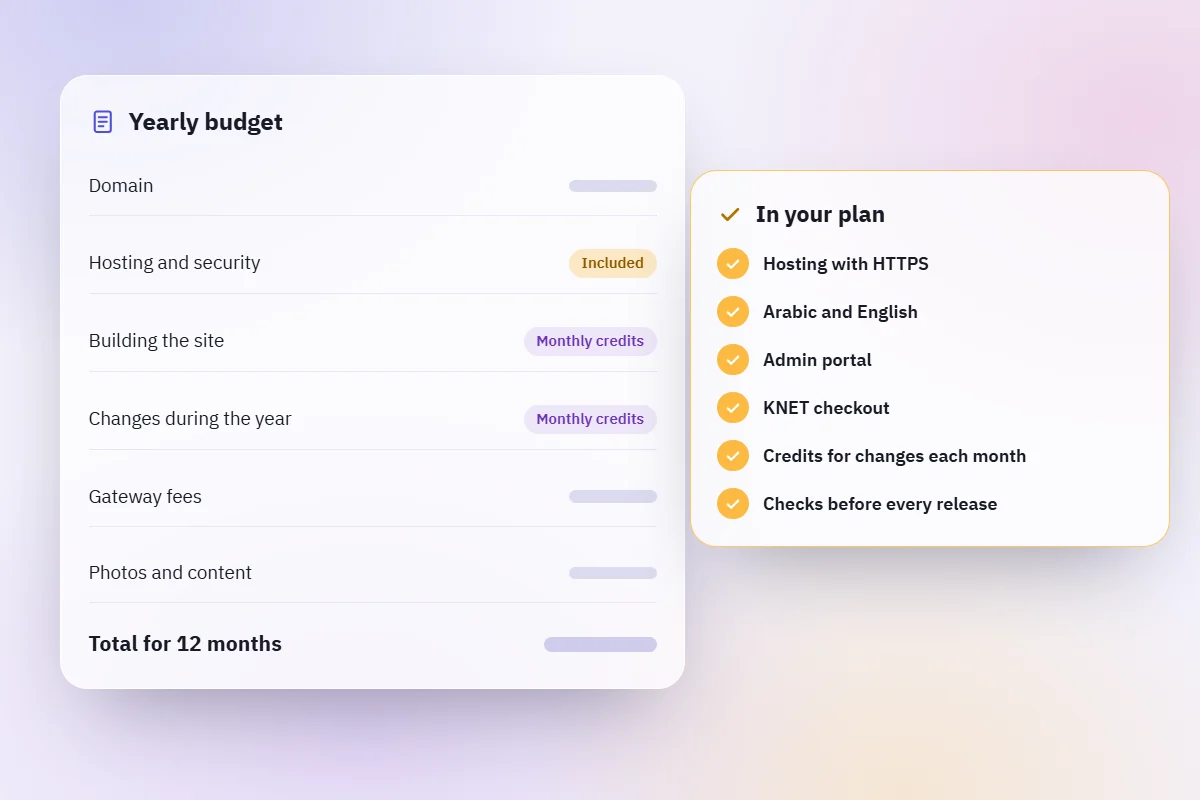
Write each quote as five lines, one per part above, for the first year and for the second. Add them up. Then look again at anything marked "free" or "included": free for how long, and with which limits? The cheapest first year is not always the cheapest second year, and a quote that leaves out the domain or the changes is not cheaper, only incomplete.
What darwaza includes
darwaza builds the software a business runs on, in Arabic and English, for businesses in Kuwait and the Gulf. Several lines that other quotes bill separately are included:
- Hosting, managed for you, with nothing to set up.
- HTTPS on every site, on its free address or your own domain, with the certificate set up automatically.
- Checks before every release: a new version goes live only after its checks pass.
- Security basics: each site that keeps data has its own database and file storage, kept apart from every other site, and sign-in and public forms are protected against floods of requests.
- Updates: changes reach your site through darwaza, so you never deploy anything.
The Free plan has one site and a free address on apps.darwaza.ai, and paid plans add your own domain and the download of your site's code and data. Credits pay for the AI work, and every plan includes credits each month. Paid plans open soon through Contact us, and yearly billing will save 10%; current prices are in the pricing section.
Customer payments work on every plan, Free included, and their fees are your gateway's own, separate from your plan: you connect your own account with UPayments, Tap, MyFatoorah or Hesabe, and the gateway charges you directly. You can start free and see what your site would include before you spend anything.
Frequently asked questions
How much does a small business website cost in Kuwait?
It depends on the route and on what is included. Add up five parts for the year: the domain, hosting, building the site, payment gateway fees and changes after launch. Ask each provider for the first-year and second-year totals in writing, and compare those rather than monthly headlines.
Why do website quotes differ so much?
Because they include different parts. One quote may cover hosting and changes, another only the first build, and a third leaves the domain and payments to you. Write each quote as the same five lines and the differences become clear.
Is a free website plan really free?
It usually covers the basics, with limits. Check what costs money later: your own domain, more sites, removing the provider’s badge, exporting your site, and the payment gateway’s fees, which every gateway charges whoever builds the site.
What should I budget for after launch?
The domain renewal, any subscription or maintenance fee, the gateway’s fees on each payment, and the changes you will want through the year, such as new prices and Ramadan hours. Your own time for updates counts too.
Sources
Facts that change were checked at the source on the dates shown.
- UPayments: pricingupayments.comChecked
- Google Business Profilebusiness.google.comChecked
- ICANN: information for domain name registrantsicann.orgChecked
- CITRA: the authority that manages .kw domain namescitra.gov.kwChecked