- payment gateway
- knet
- kuwait
- payments
- comparison
Choosing a payment gateway in Kuwait: what to compare
What to compare when choosing a payment gateway in Kuwait: payment methods, hosted pages, testing, published fees, payouts and the questions to ask.
6 min read
Updated

In short
Choose a payment gateway on five things: the methods your customers use, how its payment page works, whether you can test it before you sign, its fees and payout times, and its registration with the Central Bank of Kuwait. darwaza sites connect to UPayments, Tap, MyFatoorah or Hesabe, and this guide compares those four side by side as of October 2026.
A payment gateway is the service that shows your customers a secure payment page, gets each payment approved and sends the money to your bank account. In Kuwait the choice matters more than it looks: it decides which cards your customers can use, how soon you are paid, and how much each sale costs you.
This guide explains what to compare, then looks at four Kuwaiti gateways side by side, with the facts we could check in their own documentation in October 2026. Fees and features change, so treat it as a starting list and confirm the details with each gateway before you sign.
What to compare
The payment methods your customers use
KNET is the one you cannot skip in Kuwait: it is the debit network that every local bank card belongs to. Add Visa and Mastercard for credit cards and visitors, and Apple Pay for iPhone users who want to pay without typing a card number. Some gateways also offer Apple Pay with KNET cards, Google Pay and Samsung Pay. Ask which methods your account will have for your type of business, not just which ones the gateway supports.
How the payment page works
A hosted payment page is run by the gateway: your site sends the customer there, they pay, and they come back. Card details never touch your site, which keeps your security duties light. Embedded card forms look smoother but bring more responsibility. For a small business, a hosted page is the sensible default.
Testing before you sign
A sandbox is a test copy of the gateway, where published test cards let you run complete payments without real money. A gateway that publishes its test details lets you, or whoever builds your site, try the whole checkout while the paperwork is still in review.
Fees and payouts
Ask for the full fee schedule in writing: the cost of each KNET payment, each local card and each international card, any setup or plan fee, what happens to the fee when you refund, and how often money reaches your bank.
Registration and support
In Kuwait, e-payment service providers are registered with the Central Bank of Kuwait, which announces the companies it adds to its register. Check that your gateway is on it. Then judge the human side: how fast support answers, in Arabic and in English, when a payment goes wrong on a Thursday night.
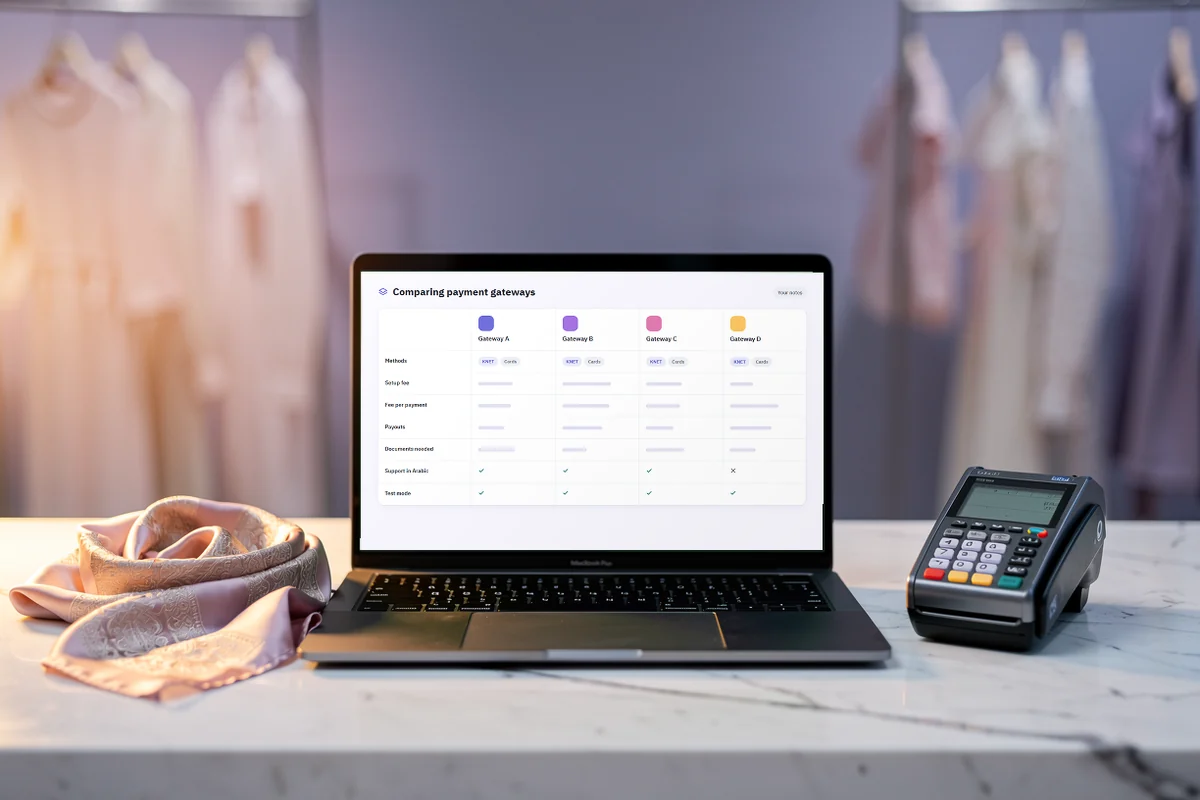
Four Kuwaiti gateways side by side
The four below are Kuwaiti companies named in the Central Bank of Kuwait's announcements of registered e-payment service providers in April and November 2024, and each one publishes test details so you can try it first. All four connect to darwaza sites today.
UPayments
- Methods: KNET, cards, Apple Pay (also with KNET cards), Google Pay and Samsung Pay.
- Payment page: a hosted payment page.
- Testing: public test keys and test cards.
- Fees: UPayments publishes its prices on its pricing page. When we checked on 14 October 2026, it listed a one-time fee of 250 KWD for its Single Merchant plan, KNET at "(0.5% + 100 fils) or (250 fils)" per transaction as the page puts it, credit cards at 2.75% per transaction, and Apple Pay with a credit card at 2.75% plus 100 fils. Ask which KNET rate would apply to you.
Tap
- Methods: KNET, cards, Apple Pay, Google Pay and Samsung Pay, plus methods for other Gulf countries and pay-later options.
- Payment page: a hosted page where the customer chooses the method, or a direct redirect for one method.
- Testing: shared test keys and test cards.
- Fees: we found no public price list; ask for a written quote.
MyFatoorah
- Methods: KNET, cards, Apple Pay, Google Pay and Samsung Pay in Kuwait; the list varies by country.
- Payment page: a hosted payment page, an embedded option, and invoice links you can send to a customer.
- Testing: a public demo account and test cards.
- Fees: set per account; ask for yours in writing.
Hesabe
- Methods: KNET, cards, Apple Pay (also with KNET cards), Google Pay and Samsung Pay.
- Payment page: the customer pays on Hesabe's own payment page.
- Testing: public sandbox details and test cards.
- Fees: we found no public price list; ask for a written quote.
Two other routes you may hear about
KNET directly through your bank
Some businesses get an online KNET terminal straight from their bank. It covers KNET only, so card payments need a separate arrangement; it takes more technical work to connect; and its fees follow your bank's tariff. It can suit a business with its own developer and a high volume of KNET payments.
A payment orchestrator
An orchestrator connects one integration to several gateways and routes each payment between them. Ottu is a Kuwaiti example. It suits larger merchants with contracts at several gateways; darwaza sites do not connect to orchestrators.
Questions to ask any gateway
- Which payment methods will my account have, for my type of business?
- Which documents do you need, and how long does approval usually take?
- What is the fee for KNET, local cards, international cards and Apple Pay? Is there a setup, plan or monthly fee?
- How often is money transferred to my bank, and is there a minimum amount?
- Are fees returned when I refund a payment?
- Can I test everything with test keys before going live?
- How do I reach support in Arabic and English, and at what hours?
- Is your company registered with the Central Bank of Kuwait as an e-payment service provider?
How darwaza works with your gateway
darwaza builds the software a business runs on, and customer payments are built in on every plan, Free included. You connect your own merchant account with UPayments, Tap, MyFatoorah or Hesabe, and the money goes straight to your account, under the gateway's own fees, which are separate from your plan. Your gateway's keys are added securely when the site goes live, never written into its code. Customers pay with KNET, cards or Apple Pay on the gateway's secure page, your site is tried with test payments before it takes real ones, and an order counts as paid only once the gateway confirms it.
For the basics of a safe checkout, read how to accept KNET and card payments online. To see the whole cost of a site, gateway fees included, read what a small business website costs. When you are ready, you can start free.
Frequently asked questions
Which payment gateway is best for a small business in Kuwait?
There is no single best one. The right gateway has the methods your customers use, a hosted payment page, test details you can try, fees you have in writing and support that answers. Compare at least two using the questions in this guide before you sign.
Can I use more than one payment gateway?
Yes, some businesses do, for example to have a backup. Each one adds documents, fees and a dashboard to watch, so most small businesses start with a single gateway that covers KNET, cards and Apple Pay, and add another only when there is a clear reason.
What is a sandbox, and why does it matter?
A sandbox is a test copy of the gateway where published test cards let you run complete payments without real money. It lets you check your whole checkout, including declined and cancelled payments, before a single customer pays.
Do payment gateways in Kuwait need to be registered?
Yes. E-payment service providers in Kuwait are registered with the Central Bank of Kuwait, which announces the companies it adds to its register. Check that your gateway is listed before you sign, and ask the gateway for its registration if you are unsure.
Sources
Facts that change were checked at the source on the dates shown.
- Central Bank of Kuwait: e-payment service providers added to the register (April 2024)cbk.gov.kwChecked
- Central Bank of Kuwait: e-payment service providers added to the register (November 2024)cbk.gov.kwChecked
- UPayments: pricingupayments.comChecked
- UPayments: test cardsdevelopers.upayments.comChecked
- Tap: test card numbersdevelopers.tap.companyChecked
- MyFatoorah: test cardsdocs.myfatoorah.comChecked
- Hesabe: sandbox test cardsdeveloper.hesabe.comChecked
- Ottu documentationdocs.ottu.comChecked